Updating the FVS Model
May 2026
The way I explain the different types of flexible systems for visual identities might have changed forever. If you read the book Flexible Visual Systems, you are familiar with the model of the two different types of identity systems: Identification through form and Identification through transformation. This model did not appear out of nowhere. It is a result of an analysis of more than a hundred existing flexible identity systems. It is not based on fiction. I have been testing the model for more than a decade, and it has proved to be helpful in explaining to students what their options are when designing a visual identity.
So, what has changed? I realised that the concept of “types” is not very systemic. A type is a static expression of something that is actually fluid. It is helpful to make something a type, because you can name it and talk about it, but it becomes limiting if you consider it the ultimate truth. I am not saying that form- and transformation-based identity systems do not exist. I am saying that they have to be viewed differently.
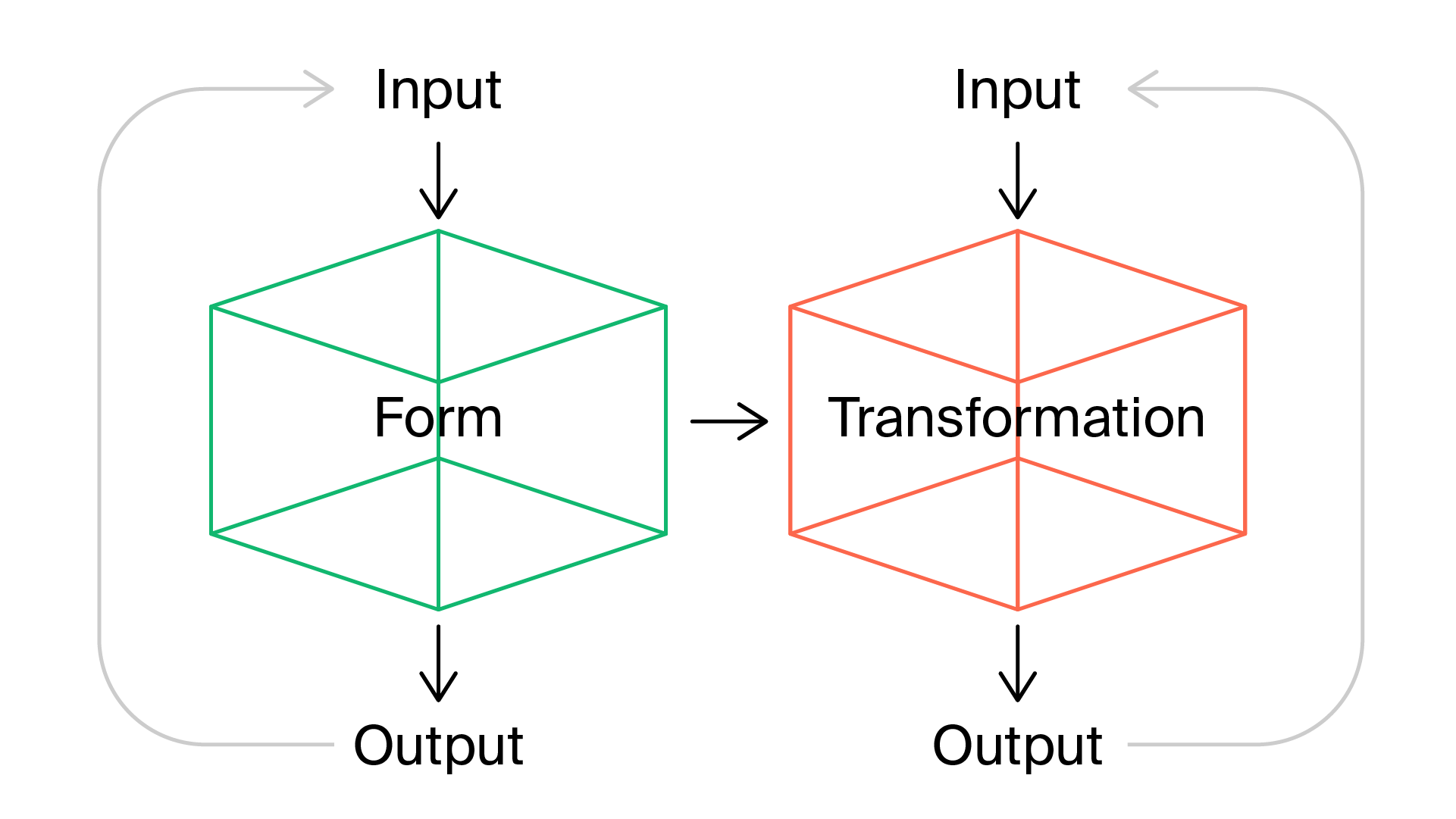
Realisation 1: There is no Transformation without Form. This link was already represented in the original model. You always need something to process, otherwise the process won’t be visible and won’t serve for identification. Imagine an image filter. You need source material, otherwise the filter won’t show what it does. What I came to realise is that the link between form and transformation can be seen as a fluent transition, going both ways. Within the same identity, a form as well as a transformation can be used for identification. Depending on the intentions and context, one or the other will be more adequate. A form can also be the basic unit of a raster transformation. In these cases, form and transformation are active identification elements/processes. In fact, if form becomes less visible in a transformation-based system, the identity shifts into a very subtle state, from liquid to gaseous.
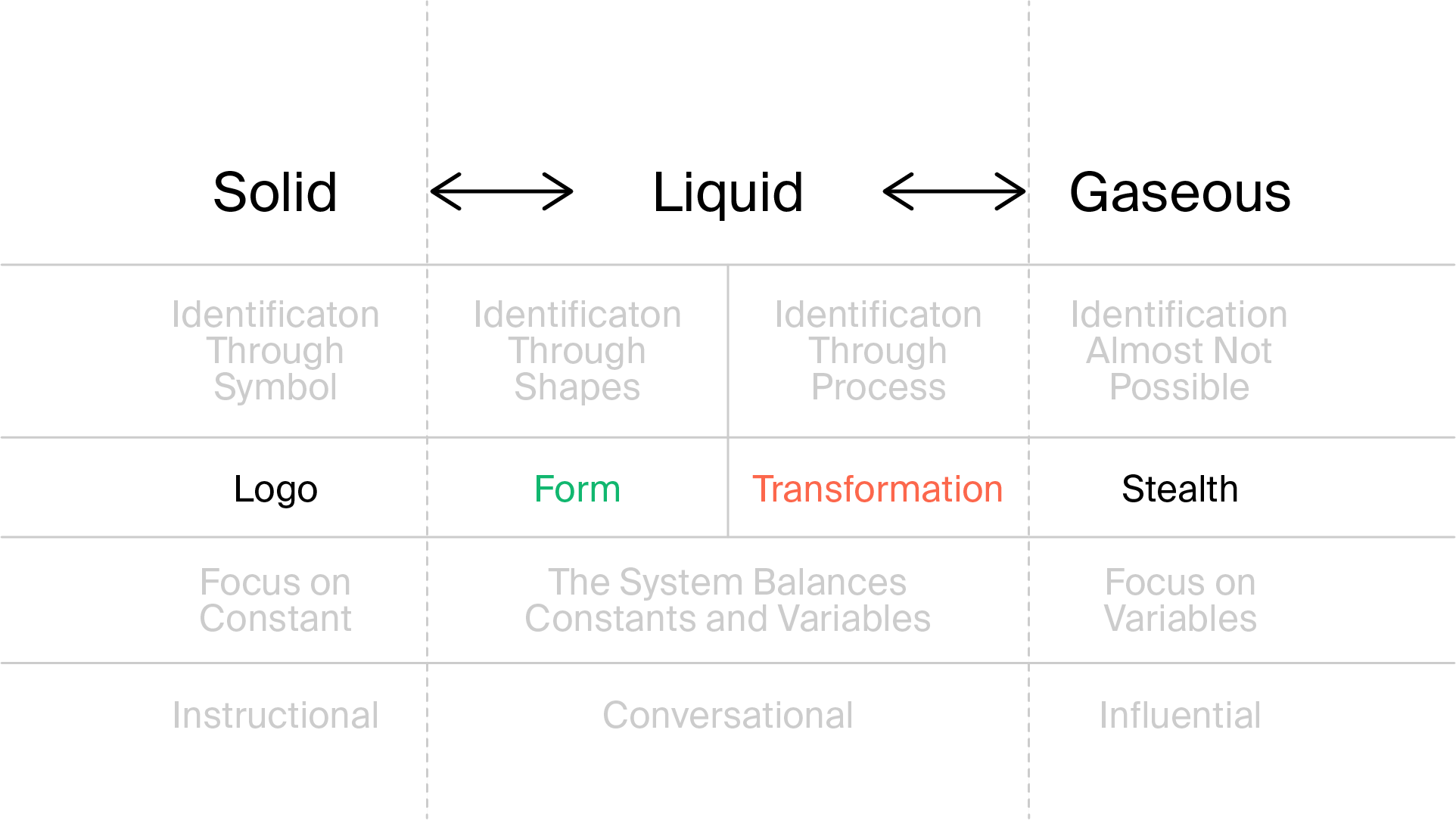
Realisation 2: In the first 20 years of this century, I still felt the need to teach that the logo-centric approach isn’t an adequate way of designing in a digital world. Now that the book FVS Atlas has shown that the systemic approach is widely spread, my brain starts to relax. I can consider the Logo-centric approach and its derivatives, the flexible logo system, as part of the same world. Like ice, the logo is the solid state of the identity system. Other elements of an identity can be in solid states, too. Anything printed is, in fact, in a solid state. While non-flexible elements have their disadvantages in flexible environments, they also have advantages. Non-changing shapes are easy to remember and use. If you have ever tried to explain to someone how to use a flexible identity system, you know what I am speaking of. It is easy to explain how to stick a logo on something, but it gets very quickly very complex if you have to explain how your design becomes responsive to its context, partly because even you don’t know yet.
The semantics of the states of matter of identity systems.
While I viewed the shift from static to flexible or solid to liquid as a consequence of a shift from analogue to digital, a historical shift, there is more to it. We still use logos and it’s not enough to explain this by them being easy to remember and use. They are perceived differently. A logo has authority. It is a symbol, not a language. It is for you to stand behind or not. It is one-directional communication and not a two-directional conversation. Oliver Vodeb brings out the big guns to explain that distinction, by declaring the brand system of Nazi Germany as the first proper logo-centric branding, the swastika obviously being the logo. While design historians usually name AEG by Peter Behrens as the first visual identity, Vodeb argues that AEG had a far less consistent system, which can be proven by the varying aesthetics of AEG’s deliverables, using less of a system and more of a style, and the fact that Nazi Germany’s visual identity had extensive style guides, defining each aspect of how to apply the brand.
While not all entities using a logo are murderers, a logo always communicates authority. A family crest, a sign on a flag, a seal of quality, it doesn’t matter which intentions are behind the symbol; a symbol is a simple message. It is binary. Either you belong, or you don’t. People seem to like simplicity and consistency, looking at outcries over logo changes in the past.
Identity systems in liquid states are perceived and used in a different way. At least potentially. A flexible system is not a symbol; it is a language that can be potentially used by anyone. Like a font, that potentially, anyone can install and use to express themselves with, but still aligns with the aesthetics of anyone who has chosen the font.
A new state that I haven’t considered before is the gaseous state, the stealth mode. Identity based on transformation can become so subtle that we do not even notice it anymore. Imagine a beauty filter of an influencer or an AI-generated avatar of a company. When filters become invisible, when avatars become normal, we live in a representational world that seems real. I am not predicting a future, but a state of the present that you and I are often in. You can see the attractiveness of the dissociation from the real world into the artificial world on social media in the form of distortion of facts, deep fakes, but also avatars in streaming or games. I am not saying that these dissociations are unnatural; our right hemisphere is very good at it and it helped us to create many wonderful things, but it becomes problematic if we overly rely on them. If we believe them to be real. The results are social anxiety, division, and confrontation. A society that has lost its constructive citizens. As Hannah Arendt would say, a person who has lost their polis, their freedom to shape society by speech and action. Not by censorship, but by loss of cognitive security.
Here it is where design needs posture. Our work has a bigger influence than we like to think. It is our profession to steer perception. If perception is influenced without revealing its intentions, it becomes a black box of manipulation. If we want a society of thinking beings, we need to give them the chance to think. We need to create conversational spaces that make the patterns, relationships and contexts visible. Our conversational spaces need that awareness and friction to allow for honest conversations.
This text could become part of a series of texts. Let me know if you are interested.
- Explanation of the original “Types of FVS” model
- Update of the model to “State of Matter of Identity Systems”
- From authoritarian logos to invisible influence
- The conversational space in the middle, patterns, relationships and context of conversational spaces.
- Conversational design is more than user interfaces with natural language. It shouldn’t be a question of how to create an interface for a machine. It should rather focus on the tech-supported interface between humans or even all life.
- Design as Conversations, Design for Conversations
- Identity as a boundary object, an evolving system.
- The democratic dimension of design. The posture in the system.